
STEP 2 - SHARING YOUR TESTIMONY - CHAPTER 13
THE VALUE OF A PERSONAL TESTIMONY
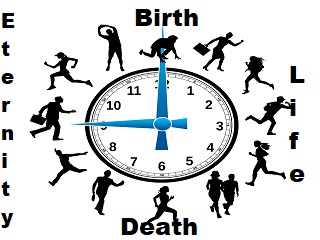
THE CLOCK OF LIFE By Robert H. Smith
"The clock of life is wound but once,
And no man has the power
To tell just when the hands will stop
At late or early hour.
To lose one's wealth is sad indeed,
To lose one's health is more,
To lose one's soul is such a loss
That no man can restore.
The present only is our own,
So live, love, toil with a will,
Place no faith in "Tomorrow,"
For the clock may then be still."
"THE CLOCK OF LIFE"
More than thirty people died while you read this poem. Every minute 105 people have died, and every hour, 6,316 souls die in the world and pass into eternity to meet their Maker. Question is what are we doing to reach the non-Christian with the Gospel message?
Many people feel paralyzed in talking to people about their faith in Jesus Christ. Some Christians assume it is the Pastor's duty or the full-time Christian worker's responsibility to preach the Gospel and share the message of Jesus Christ. Jesus said before He left in Matthew 28:18-20, "GO," not stay.
Let's talk about the power of your personal testimony in bringing people to Jesus Christ. Here are some common reasons people give for not sharing their faith?
- What makes a credible witness?
- How can I share my testimony in a way that makes sense and will encourage people to believe in the Lord Jesus Christ?
- How do I guide the discussion on the subject of Jesus Christ?
- How can I overcome my fear of not being accepted, or thought weird?
- How do I overcome my fear of talking about Jesus Christ?
- How do I overcome my lack of confidence that God can use me to bring someone else to Christ?
EXAMPLES OF TESTIMONIES
The Bible is filled with accounts of individuals giving their testimony. Check out the following situations of personal testimonies and see what you can gain from them. Use the techniques you have discovered in the previous study guides.
A. The woman at the well (John 4:28-29)
- What did she explain?
- Who did she witness too?
- Why did she pick this specific kind of testimony?
B. The man that was born blind (John 9:13-34)
- Who did he witness too?
- What did he talk about?
- What was the reason for the testimony?
- How was his testimony received?
- How did he handle opposition?
C. Paul's testimony before King Agrippa.
The Apostle Paul gave an excellent example for you to follow when he provided his testimony of conversion to King Agrippa in Acts 26:1-23.
- Life Before Conversion (Before) (Acts 26:4-11) - A religious life, however, opposed to God.
- Conversion (How)(Acts 26:12-18) - Recognized and acknowledgment of a need and commitment to Christ.
- Life After Conversion (After) (Acts 26:19-23) - A transformed life.
Only a few believers have as remarkable a testimony as Paul However; all followers can follow the very same basic outline.
Why Should I Share My Story?
Jesus sent out His followers into the world to share the Good News. He also sends out you and me. (Acts 1:8.)
In his first letter, the Apostle Peter asks us in this manner: "Always be prepared to give an answer to everyone who asks you to give a reason for the hope that you have."(1Peter 3:15). One of the most efficient and practical tools you have for sharing your faith is the account of how Jesus Christ gave you everlasting life and how He has enhanced and improved your life. The Apostle John wrote, "We proclaim to you what we have seen and heard." (1John 1:3.) John was declaring about his relationship with Jesus Christ.
When the Apostle Paul shared before King Agrippa (Acts 26), he told him clearly, directly, and logically about his life before salvation, how he met Christ, and what his life and experiences were like after conversion. Paul's testimony takes about three minutes to present aloud in a conversational manner.
Although it is crucial to write out your testimony, the purpose is not to memorize it and deliver it word-for-word. The goal is to help you communicate your experience with words so your listener can understand and know what has happened to you. The choice of the right words and the flow of your story is essential in telling your testimony. And understanding how to start and how to end is critical.
As you begin your outline, ask the Lord for wisdom, understanding, and insight in just how to share your testimony. Be open to advice and recommendations from others. A lot of people have said that this work effort on their testimony has been hugely beneficial and helpful. Take time to practice and sharpen this tool of sharing the Gospel with having "an answer to everyone," many people have come to Christ. Trust and believe God to help you to accomplish this task in working hard. Invest time, care, thought, and prayer to this significant and influential part of discipleship.
Preparing a Personal Testimony: General Comments
What is a testimony? Sharing about your relationship with God. Your life before Christ, your coming to Christ (conversion), and your life in Christ (after.)
1. Primary Purpose
The main aim is for you to create, develop, complete, and give your personal testimony in approximately 3 minutes from an outline on a 3 x 5-inch card.
2. Amount of Drafts
The amount of time, work, and energy it will take to prepare and develop your testimony will differ significantly from person to person. This has little to do with your intellect or spirituality. It is the issue of the complexity of your testimony. Some stories are exceedingly harder to express clearly. Some have to be condensed to the proper length.
Others need to be extended. So there are many factors that influence how long it will take you to create and develop your written testimony. If yours comes easy and fast, don't be smug about it. And if the preparation and development seem to be more challenging for you than others, don't be deterred. Be faithful in prayer for yourself and others that might join and connect with you in this vital task.
3. Difficult and Challenging but Rewarding and Satisfying
Many find this work on their testimony to be hard and sometimes discouraging and daunting. On the other hand, several find it to be the most effective, stimulating, and helpful. Your approach and how motivated you are to do the work can make it as easy or hard on developing your testimony. Like anything else, you have to make up your mind and work hard! Pray for God's wisdom, guidance, and direction. It will be the best life decision you have made.
IMPORTANT: For the next few study guides start creating your rough draft testimony using:
THREE SEPARATE SHEETS OF PAPER labeled one BEFORE, one HOW, and one AFTER. Essential to start now with a rough draft, anything that relates to your testimony below.

Helps for Developing Your Testimony
Testimonies can be made on many topics and adjusted for different audiences. The priority is your salvation testimony. This testimony will be intended to give to a non-Christian and will be best suited for a one-on-one sharing or in a small group setting. It will help as a "door opener,"not a "convincing tool." A lot of people are not ready to be persuaded that they need Christ but can often start to ask questions about the Gospel after an unoffending introduction of your testimony.
The Outline of a Salvation Testimony
a. Before – A brief description of what your life was like before you became a Christian.
b. How – Your exact steps in becoming a Christian.
c. After – Revealing the changes in your life as the decision to have received Christ.
Guidelines for Preparing More Specific Content
1. Make it sound casual, informal, and natural.
Avoid literary sounding remarks like, "I view the redden sunrise, and I contemplate." Use your informal vocabulary. Talk in a normal voice.
2. Do not use "you" in your conversation, say "I" and "me"
Share in a calm voice and do not preach at people. This helps keep your story friendly, personal, and gracious. Folks like to hear the events of others told in the first person.
3. Avoid religious words, phrases, and jargon.
Instead of religious words like Believe or Sin, use something like, "I invited Jesus to come into my life through prayer." Or "disobedience, turning my back on God."
"Instead of Accepted Christ" or "saved" use, something like, "I decided to turn my life over to God," or "God forgave me of my failures," or "I became a Christian and was delivered from the consequences of disobedience."
Instead of Prayed Through Christian, use something like, "a sincere prayer" or "a committed Christian" or "a real Christian."
4. Speak in general terms so more people can identify and relate to your story.
Don't name particular churches, groups, or denominations. Avoid using dates and ages. (Poor: "I was eighteen years old when I became a Christian." Or "We moved to the country in 1992.")
5. Inject some humor and personal interest.
When an individual smiles or laughs, it decreases tension. Humor and joyfulness are disarming and enhances attention.
6. Word pictures develop and builds interest.
Don't just say, "I grew up in the country. "You could quickly describe the farm so people can imagine it.
7. The "BEFORE"
Include both the bad and good aspects of your life.
Have a back up of interesting non-spiritual material at the beginning.
(1) Examples of "good aspects" – hard-working. wanted to excel, desire for higher education, and cared for others.
(2) Examples of "bad aspects"– self-centered, greedy, inferiority complex, selfish, angry, and wanted more money.
8. The "HOW"
1. Write and tell the Gospel clearly, simply, briefly, and concisely. You need to include:
(a) We all have sinned.
(b) The penalty for sin.
(c) Christ's paid the price for our penalty.
(d) The necessity to receive Christ.
2. Make the Bible ( God's Word) the authority.
(a) Weak: "Don shared with me that I missed the mark and needed to be forgiven."
(b) Better: "Don shared with me that the Bible said …"
3. Use the term pray when relating to receiving Christ. The word pray reveals what a person needs to do.
: "I prayed and asked Jesus Christ to come into my life and He gave me the gift of everlasting life.")
9. The "AFTER"
Immediately end with two personal benefits of becoming a Christian that relate to the listener.
These may be recent or new benefits. Close your testimony with something like, "Now I know that God is always there for me." Or, "But the greatest benefit is that I know I have eternal life."
RELEVANT: The listener often comments on the last point you say in your personal testimony. If the listener's remarks are on eternal life, the opportunity is open for you to introduce and present the Gospel to the person.
10. Avoid dogmatic comments that skeptics can question.
Examples are:
(1) Weak: "I prayed, and I recognize Christ came in."
(2) Weak: "God has given me a wonderful job, spouse, and children."
(3) Better "I prayed and asked Christ into my life. Because of this, I have experienced love, peace …"
11. Analyze.
Decrease clutter and confusion.
The Flow of Your Preparation
1. Before you begin creating and writing, pray for God's help. Look to the Holy Spirit for wisdom, understanding, and insight as you work on your story.
2. Use three separate sheets of paper labeled one BEFORE, one HOW, and one AFTER. (Very important and necessary for the next few study guides.)
3. Write out your initial draft, using your notes from the three sheets of paper. (It will usually take 4 to 5 minutes or more to read it out loud.) Apply the above 11 guidelines.
4 Make improvements and adjustments to the long draft. Try and get someone to assist you with this step, if available.
5. Cut your long draft down to between two-and-one-half and three minutes when you read it. Again, if possible, get help from a friend.
6. Outline your presentation on a card 3 X 5. Determine to give your story (testimony) using only your outline.
7. Next, learn to give your testimony in three minutes without the outline aloud to yourself.
8. Practice, practice, and practice at looking at a mirror giving your testimony without the outline. Or use a device to tape your story to listen too. Practice on a Christian and listen to the person's feedback.
We all are imperfect, so do not worry about a flawed presentation. It is the Holy Spirit that does the work of drawing and convicting the lost. We just have to be prepared and available for the Lord to use us in all our imperfections. If you wait till you are a mature perfect Christian, it will never happen. A lot of times, a new Christian is excited to tell others about Christ that usually nothing can stop them. Yes, we will all make mistakes, but that is how we grow in sharing the Gospel. Sharing the Gospel is similar as we share; we grow by the Holy Spirit in experience, wisdom, and confidence. Step out today and pray for an individual you can share with.
Two Patterns For Sharing Your Story
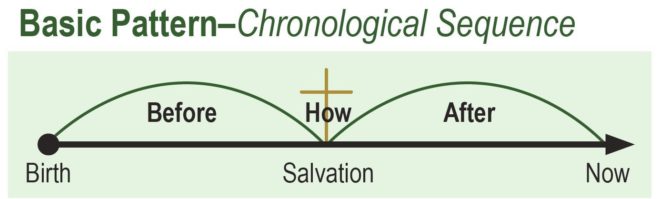
1. Chronological Or Historical
The Chronological sequence tells your story what your life was like "BEFORE" you trusted Christ; and then the "HOW" you trusted Jesus for your conversion experience, and then the "AFTER" or "NOW" the changes in your life after conversion.
You might use this format:
a. If you were converted in your teen or adult years
b. If you have enough information to share before your conversion. Especially if your "BEFORE" story is compelling and engaging, and your "How" experience clearly explains the Gospel.
c. If your how experience (conversion experience) is lengthy and is an essential part of your story the, "HOW" would be longer, and the "BEFORE" would be shorter.
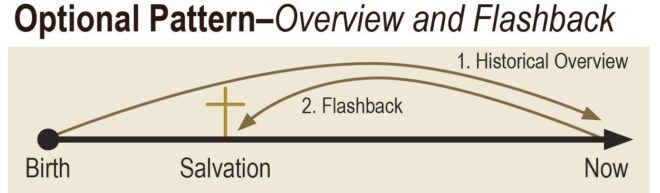
2. Overview-Flashback Method or Phaseback Method
For those that accept Christ as a young child, the Overview and Flashback pattern could work better. It is often difficult to relate to an individual in the secular world with a testimony of a person who has accepted Christ at an early age and has grown up in a Christian home. The listener who has no idea of Christ may find no identifying things or circumstances to relate too. To fix this, we can use a testimony called the Phaseback Testimony to assist the person who decided for Christ in their earlier years.
First, the Phaseback Testimony initially concentrates on an overall picture of what the person had done in their life – such as education, marriage, job, family, and the present.
Secondly, the testimony will then phaseback to the time of conversion at a young age, which illustrates how the power of Christ affected their decisions as they grew and matured in their walk with Christ.
Thirdly, the benefits of growth and conversion can be identified either in self-image conflicts, jobs, relationships, or raising children.
It will be necessary, also, when phasing back to precisely convey the message of the Gospel that began its transforming work in your life.
For those that accept Christ as a young child, the Overview and Flashback pattern could work better. In this approach, you give a fast, engaging overview of your life right up to the present. This pattern takes the place of the "BEFORE" in your story. The "NOW" and the "HOW" (Salvation) play an essential part in the overview of your life.
You might use this format:
a. If you came to Jesus at an early age.
b. If you had a lackluster early life, but a more engaging and compelling adult life.
c. You accepted Christ as a child, but your experience was portrayed by spiritual immaturity—a lifestyle comparable to that of a nonChristian—until you came to a time of crisis and problems and recommitted your life to Christ. Assess whether your childhood conversion experience was real. If you decide it was not genuine, then use format #1. Chronological Pattern as your guide.
d. Saved very young and have not much to say about the "Before" coming to Christ. If that is the case concentrate on the faithfulness,goodness and thankful to God and that you realized the need to come to Christ and His great provision provided on the cross at an early age
e. If your "HOW"is not very long.
The Power of a Personal Testimony
1. Non-threating - A non-Christian will be more open to listening to your testimony, than a sermon or Bible teaching.
2. Personal - Unchurched people can relate more clearly to your life experiences and situations. Shows in a personal way that God is still real and alive in lives today.
3. Speaks for itself - Non-Christians can argue scriptures or teaching, but it is very tough to argue about someone's personal experience.
4. Arouses people's interest in Spiritual things - Can increase a desire for God and stirs up questions.
5. Powerful - The Holy Spirit can use your testimony to convict those that hear your story.
Common Drawbacks in Your Initial Testimony Preparation
1. Too Careful on the First Draft.
A lot of people have a habit of being too careful and critical of the rough drafts. You are not trying to make a flawless presentation the first time. Put something on paper! Put a lot on paper! It is simpler to cut something down than to increase it.
IMPORTANT: Remember to have three separate sheets of paper one labeled BEFORE, one HOW, and one AFTER.
2. Too much Reminiscing and Retrospecting.
a. Some become discouraged, depressed, and sad because of too much soul-searching, or thought of past unhappy experiences and events.
b. Some like to "replay" and "relive" previous incidents that the work never gets done.
c. Some become too distracted by trying to make right old conflicts.
3. Wanting to introduce Spiritual Content Too Soon.
Beginning with spiritual and Christian material too soon in the testimony is not good. Let the non-Christian get familiar with you as a regular individual first. Also, spiritual content may be too strong all the way through the presentation. Let an individual get to know you as another human being and relatable.
4. Concerned Too Much About When You Accepted Christ.
Sometimes, there are a few possible times when a person may have been converted. A Christian friend can help you figure this out and also help if your situation is more complicated than others. As you think about this, you will often come up with new insights about yourself. Meanwhile, put in writing the things that are obvious and clear to you.
5. Can't Remeber A Date.
Some folks cannot remember a precise date or set of events associated with their salvation. However, no individual is saved without coming to an understanding of conviction of sin, a turning to God for the answer, and a deliberate, mindful, and conscientious decision to receive Christ. Important not to mislead anybody into believing that salvation is something vague and uncertain that they may have experienced but don't remember.
6. Procrastinating Because It Is Hard Work.
It will take you a lot of time and work to complete your testimony. And if you are waiting for when you have more time or feel like it will not make it any easier. The quicker you jump into the work, the quicker you will be enjoying the fruits of your labor.
CREATE - WRITE - EXAMINE - CRITICIZE - REVIEW
PRACTICE - PRACTICE - PRACTICE
It takes plenty of effort and time to create a faith story that is logical, clear, brief, and that includes vital Gospel content. The only way is to start putting your faith story in writing. Ask other Christians for helpful feedback. Tweak your testimony, then keeping practicing it to get more feedback. Continue this method of scrutinizing, tweaking, evaluating, and practicing it until:
a. You can say it from MEMORY in three to four minutes that does not sound memorized.
b. It embraces the Gospel in a meaningful, compelling, and engaging manner.
c. THEN GO SHARE THE GOSPEL!
1. Before (Relate – "I was blind") (one separate page)
- Give some background when it helps relate to the listener (your family, age, education, work, and past experiences.)
- Don't overemphasize or exaggerate the bad things that happened. These can be detracting and can build up and magnify sin.
- Be specific, and don't generalize. Always be brief when focusing on important events, issues, or phases of your life.
- Admit up to your mistakes and blunders. Our message should not blame anyone else.
- Leave out incriminating details or names.
2. HOW (Reveal – "Jesus accepted me.") (one separate page)
- Provide specific details and circumstances of how you committed/recommitted your life to Jesus Christ so that the listener would know by hearing your testimony on how to commit their life to Christ. Be decisive, specific, and understandable.
- Focus on Christ, not on yourself. The central key is what God did and your response to accepting Christ.
- If conversion occurred over some time, concentrate on a significant turning point, and share what you realized and what happened as you began to follow a personal relationship with Jesus Christ.
3. After (Rejoice - "Now I can see.") (one separate page)
- Was there one meaningful scripture verse that had an influence and impact on you? Share the Bible verse if you have one.
- Give real changes in your life. Share the benefits and helps of having a new/deeper connection and relationship with Christ (e.g., God's love, a new outlook on life, forgiveness, fellowship, freedom from fear, loneliness, anger, despair, etc.).
- Never give the impression that everything is perfect now, but instead tell how Christ helps you in all of your struggles. Say something like this, "I still have occasions when I'm worried, but the difference is now I understand I am not alone."
Next Study Guide - Chapter 14 - BE RELATABLE - BUILD RELATIONSHIPS
Fun Contest: we will pick one testimony to win a free Bible once a month.
Your testimony will be judged by its sincerity and thought that went into it. Everyone's story is important to God and us.
Join the Contest here.
See you tomorrow. We will be looking at sharing your testimony in more detail.
RECOMMEND:
 PRAYER BOOKMARK IN SHARING THE GOSPEL PDF DOWNLOAD
( Recommend Printing Bookmark PDF To Use In Your Bible - Makes 4 Bible Bookmarks.)
PRAYER GUIDE IN SHARING THE GOSPEL PDF DOWNLOAD HERE
(Keep a copy in your Bible.)
Copyright 2016-2018. Questions God. Com. All Rights Reserved.